
First Betting Interval - 2
- Player 4 folds.
- Player 5 raises 10,000 chips.
- Player 1 (dealer) folds, as doe’s player 2.
- Player 3, whose pile is getting somewhat low, decides this is the optimum time to bluff. He calls. There are now 40,000 chips in the pot limit.
The flop comes ♣ A, ♦ 9, ♠ 2.
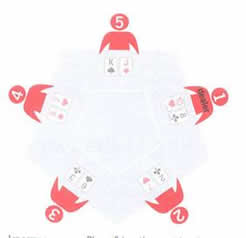
1ST BETTING INTERVAL Player 3 has the worst hand at the moment and has an almost negligible chance of winning the hand.
Second betting interval
- Player 3 goes ‘all-in’, with 45,000 chips. The pot is now 85,000 chips and if player 5 calls, that will be the end of the betting. The players would expose their cards, the dealer would expose fourth and fifth street together, and the better hand would take the pot. If player 5 wins, player 3 is out of the competition.
- So what does player 5 do? We know both hands so it is obvious to us he should call the bet, as he is favorite. But the fact that player 3 called his original raise and then went all-in after the flop suggests to player 5 that he has probably paired an Ace, which would make player 5’s chances very small indeed. In fact, he needs fourth and fifth streets to help him; Q, 10 or 10, 8 for straight or K, J for two pairs, which might not win anyway. Is it worth risking 45,000 chips in case player 3 is bluffing?
The chances are that player 5 will fold, and player 3 will pick up the pot of 85,000 on a hand of ♠ 6, ♣ 3. Of course, only 22,000 of that is winnings. But he has retrieved his big blind is fine for another round or two.
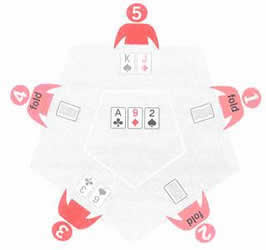
2ND BETTING INTERVAL With only player 5 still in, this is an ideal time for player 3 to bluff.
OMAHA
Omaha is a game of increasing popularity, possibly approaching seven card stud and Texas Holdem as being one of the most widely played versions of about Poker. It is a new phenomenon, and many authoritative textbooks published before the 1980s fail to mention it. The higher number of cards from which the final poker sense hand can be made, and therefore the chance of holding better hands, are the reasons for its success.
Outline of the game
Omaha is a very similar game to Texas Holdem – the difference lies in the number of hole-cards and so the number of cards available for making the final hand.
- After the usual preliminaries of shuffle, cut and the top card being burned, four cards are dealt face down to each player. One of the anteing systems is used (i.e. either all put in, dealer puts in, or there’s a small and bigs blind, etc.). Players examine their hole-cards and a betting interval takes place.
- Three community cards (the flop) are then dealt face up to the table. There is then a second betting interval.
- A fourth community card (the turn) is then dealt face up to the table and a third betting interval takes place.
- A fifth and final community card (the river) is then dealt face up to the table and a fourth and final betting interval takes place.
- There is then a showdown, and the player with the best five-card poker hand wins.
So the game is identical to Texas Holdem except that each player has nine cards (four hole–cards and five community cards) instead of seven from which to make his best hand. However, there is a restriction: players must use two of their hole-cards and three of the community cards.
This seemingly small difference from Texas Holdem does, in fact, make Omaha a more complex game and new players should familiarize themselves with the possible hands before playing for money.
Sample hand 1
The player with the hand below finds his hole-cards offer the promise of the top flush in hearts – he needs three hearts from the five community cards to come. After the flop, he still has this possibility, but also now has the chance of various straights, requiring a 9 or 6. The turn destroys his chance of a heart flush, but completes a straight. However, the river gives him a fifth spade, making his best hand a back-door Queen flush.
Flushes and straights are common in Omaha, since if three cards of a suit, for example, appear in the five communal cards, it only requires one player to hold two more of that suit among his four hole-cards to have flush.


sample hand 2
The hand below contains three 10s and an Ace, but the holder cannot think of the chance of four of a kind or even a full house, because he cannot use all three 10s. Remember, he can use only two of his hole-three. The flop comes up with another Ace, but, of course, this doesn’t give him a full house. Two pairs, even Aces up, would not win many deals of Omaha. Still available is an Ace flush in hearts. The turn is useless, but the river provides another Ace.


This unlucky player now holds three Aces and three 10s, but still cannot claim a full house. He must use exactly two hole-cards, so can claim the triple Aces but can use exactly two hole-cards, so can claim the triple Aces but can use only one of the 10s. His best hand is as shown. Although the communal cards show that there is no chance of a player holding a flush (there aren’t three cards that could be used to form one), the triple Aces are not sure to win. Every player will have the two Aces at his disposal. A player who holds the fourth Ace and a card higher than 10 will beat the hand, as will a player who holds the fourth Ace with 9, 8, or 2, as well as one who holds a pair of 9s, 8s, or 2s, because he will complete a full house